












Remarks
| The following presentation was given by Adam Alonzo during the exhibition opening reception on February 23, 2006. |
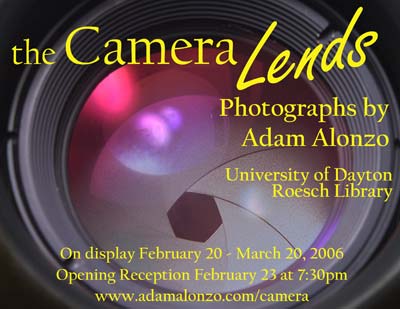
Good evening, and thank you for coming. Many of the people in this room tonight were also here about a year ago for the opening of my first photo exhibition called 200 DAYS. 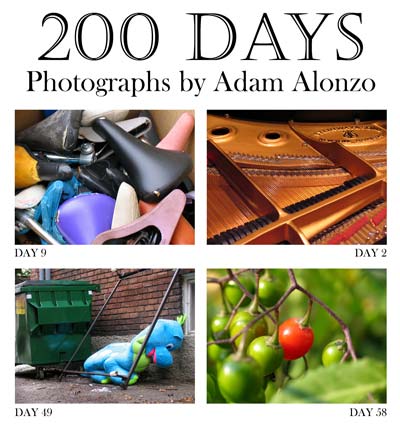
People said nice things about the pictures, and I was pleased with the turnout. But one person present believed that I deserved greater exposure. So the next day, Georgie Woessner, the General Manager of Dayton Public Radio, went into action. Since she has the local media wrapped around her finger, she arranged for me to have an interview with the Dayton Daily News. A reporter named Pam Dillon contacted the University to track down the guy in the library named Adam who takes pictures. She was put in touch with a student employee named Adam whose hobby is photography, so she began to ask him questions. But the answers he gave didn’t match what she’d already been told about me, so she ended that conversation, and the student’s hopes for fame were dashed. The reporter finally connected with me, and we met for an interview. That was on a Thursday, so I thought that the article might be published on Friday or Saturday. Then on Friday night, I ran into Ron Rollins at the Schuster Center. Ron is the Arts and Entertainment editor at the Dayton Daily, and we have been casually acquainted for several years. We chatted for a while and as he was walking away he said, “By the way, that article will come out in Sunday’s Arts section.” It was pretty crowded in the Schuster Center that night, so there wasn’t enough room for me to get down on the floor and kiss his shoes. I should point out that the daily circulation for the paper is about 180,000, but Sunday circulation is 230,000. On Saturday, I made some important revisions to my Web site (such as telling people how they could buy pictures), and then on Sunday (even before I was out of bed) people started hitting the site. Here’s a chart that shows the number of visitors during that month. 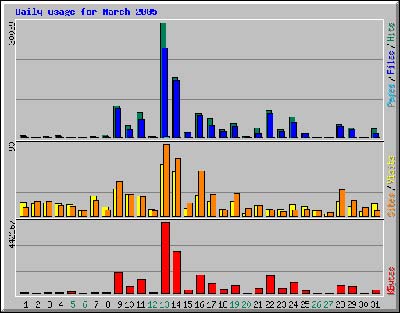
The first small increase came after the opening reception, and the big spike occurred after the newspaper coverage. Pam Dillon wrote a nice article, which told the story of how I was waiting for a haircut one day in May 2004, picked up a magazine, and saw an ad for a new Canon digital camera. A few days later, I bought the camera and began my new life as a photographer. I sometimes wonder what might have happened if I had seen some other kind of advertisement – like for scuba diving equipment. 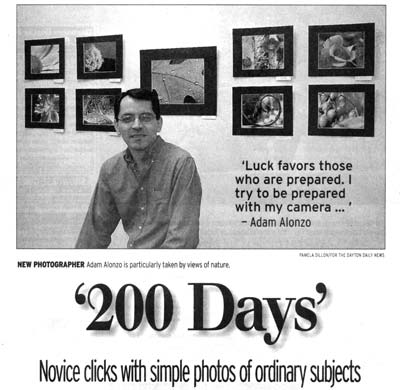
The headline of the article refers to me as a novice, which was and still is a fairly good description. It’s not that I’m very experienced or especially skilled at photography, it’s just that I do it almost all the time. I take more pictures before 9:00am than most people take all day. And simply from a statistical standpoint, if you take several thousand pictures during a period of, say, 200 days, you’re likely to end up with 50 or so that are worth hanging on the wall. The reason why I take so many pictures is to keep up my 5-a-Day Web page. Ever since I bought my camera on May 25, 2004, I’ve put five pictures a day on my site. Though it has sometimes been very difficult, and I often question how long I can continue, I have not missed a day. Here is the current Web page showing February 2006. 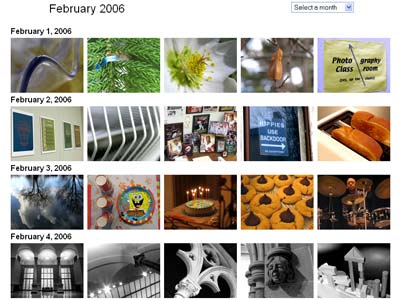
The 200 DAYS exhibit came and went, and brought me into contact with a lot of new people, and renewed ties with others whom I hadn’t heard from in many years. One enthusiastic viewer was Denise Darling, the Director of the Woodland Cemetery Foundation. Woodland is right across the street from UD, and I often go there to take pictures. She sent an e-mail asking me to put together another exhibition in the Woodland Mausoleum, and she also suggested I take part in an upcoming photography workshop to be held there. When she mentioned the workshop, I thought it sounded like something I ought to attend so I could improve my skills. But what Denise had in mind was for me to be one of the presenters, along with Skip Peterson, the senior photographer at the Dayton Daily News, and Brother John Lemker, a veteran nature photographer. Dubious of my own qualifications, I nevertheless took the opportunity, and that led to another exhibit and another newspaper article. This story came out only four months after the first one, and in this headline I have been promoted from novice to expert. 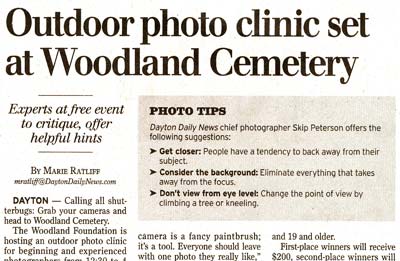
The workshop was a good experience, as I tried to summarize what I had learned from 14 months of picture-taking. The exhibition was called Out of the Ordinary, and it was smaller in scale, but I appreciated the positive feedback I received from people who attended. 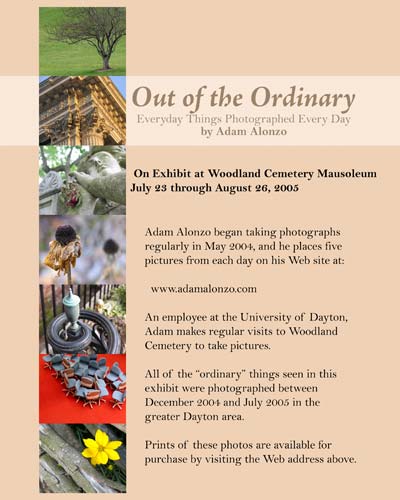
The entire show, just like my 200 DAYS exhibition, is available for viewing on my Web site. The current exhibition is made up of pictures I’ve taken since my Out of the Ordinary show in July. I could’ve easily brought back some older pictures that were popular in previous exhibits, but because of my daily photo routine, I’m strongly driven by what’s new. Each picture has a label that shows the date it was taken, so you can see that all were made since late summer. There is one exception to that statement, however. This picture was actually taken in May 2005. 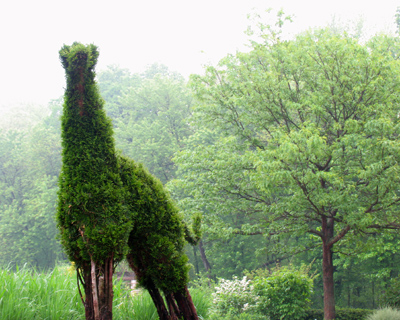
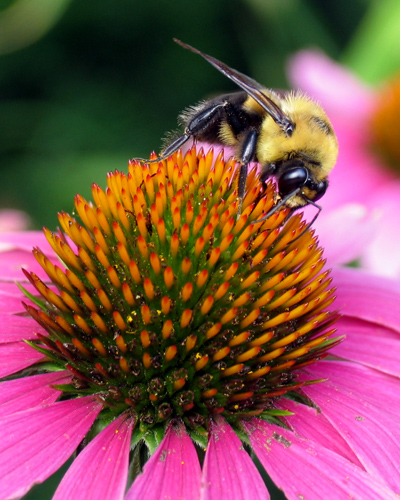
I planned to include it in my show Out of the Ordinary at Woodland, and actually hung it on display there. But when I went back a couple days later, it had disappeared and nobody knew what had happened to it. I like this photo a lot, so I decided to give it a second chance in this exhibition (though I’m keeping a close eye on it). Another reason why I included dates on the labels is so you could get a sense of chronology among these pictures, and thereby track my artistic development. Because, believe me, going from novice to expert in only four months was a grueling experience full of change and growth. Take this picture, for example, from my first exhibition 200 DAYS. I photographed this bee and flower in the Oregon District on June 27, 2004. 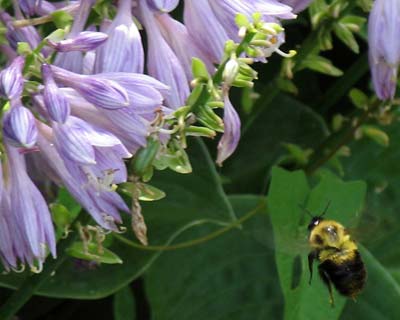
In my next exhibition, I showed this picture, a bee and flower in the Oregon District, photographed on April 4, 2005: 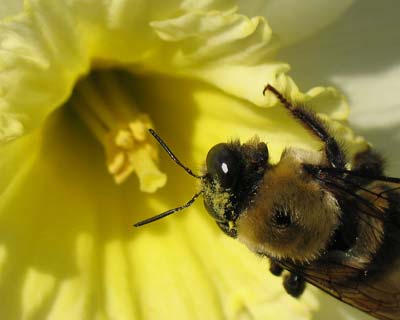
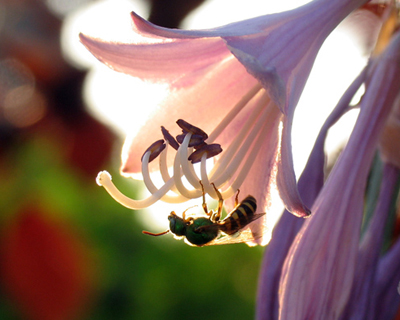
And now, in this show, we have two bees on two flowers in the Oregon District, taken in July and August 2005.
Some might say there is a small degree of repetition here, but that’s just nonsense. I mean, they’re completely different bees! I don’t even think they know each other. In the 200 DAYS exhibit, the largest section was made up of photos of people; a few of them were posed portraits taken under controlled conditions, and the rest were candid shots. In this show, the people section is again the largest and there is only one posed portrait. However, a couple of the pictures in this section blur the line between candid shot and portrait. 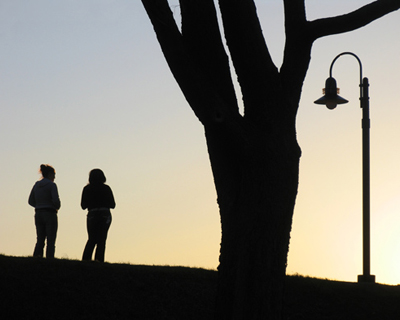
I never saw these girls before, and haven’t seen them since, but did ask permission to take their picture. They were agreeable, and cooperative when I shouted at them to “move a little closer to the tree.” 
Likewise, I saw this young lady ice skating at RiverScape on the day after Thanksgiving. She just happened to stop right in front of the guy with the camera in order to adjust her hair. It’s hard to see here, but her hair is a kind of metallic red – a color that does not occur in nature – and her eyes have bright pink eye shadow. I asked if I could take her picture, and she said, “I don’t care” (which means, “Yes, please do.”). She too was cooperative and gave me a nice smile, but since I wanted to be sure to get a good picture I took several shots. As I did, she grew increasingly dubious. 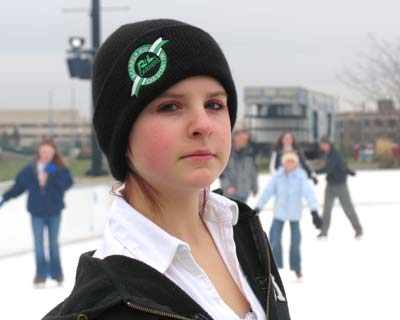
Maybe my next exhibition should be called Strangers with Cameras. I had an odd experience recently as I was on a downtown sidewalk taking pictures of a building. I had the camera pointed up and wasn’t really paying attention to the people around me, but there was a woman with two children nearby. She had a baby in a stroller and a little girl of about six or seven years old. I gradually became aware that she was speaking urgently to the older child: “Come over here. Come here now! COME HERE RIGHT NOW!” So the kid walked three feet closer to her mother, or three feet further away from me. Then her mother said something I’ll never forget: “Didn’t you listen to what the policeman said?” I don’t know for sure what that meant, but I imagine a scenario where the little girl went to school one day and a police officer talked to her class about how to avoid getting kidnapped by creepy people on the street. It made me think maybe I ought to start shaving more often, or at least stop muttering to myself as I take pictures. So now you know roughly when and how all of these photos were acquired, but you may be wondering about the title of the exhibition. Is that a misspelling, or just something terribly clever? One person heard the title and asked me if I had a cold. Well the idea came to me last fall, before I even had an exhibition planned to attach the name to. And just to see if anyone else had already used it, I did a Web search on the phrase “the camera lends.” 
I didn’t run across any other photography shows or books or essays with that name, but I did discover that there are a lot of people out there who don’t know how to spell. I found many instances of “lens” being spelled with a “d,” such as “It’s important to keep the camera lends clean.” For my purposes, “lends” is a verb, and it refers to the many important gifts that the camera gives to us. Probably the most obvious thing that the camera lends is permanence. Though our eyes perceive the world as a series of fleeting images, the camera captures those passing moments and holds them for us forever. In my mind, the word “beauty” is directly connected to the word “temporary.” The poet Emily Dickinson compared beauty to a butterfly and warned that if you pursue it, it simply flies away. 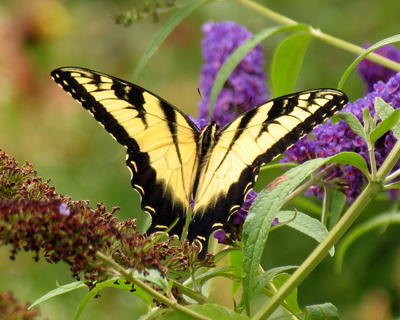
Well, what does she know? The camera lends me the power to permanently capture the image of beauty, even as the beautiful thing itself vanishes, or continues the inevitable path to decay. William Shakespeare wrote in one of his sonnets about how “every fair from fair sometime declines, by chance, or nature’s changing course untrimmed.” 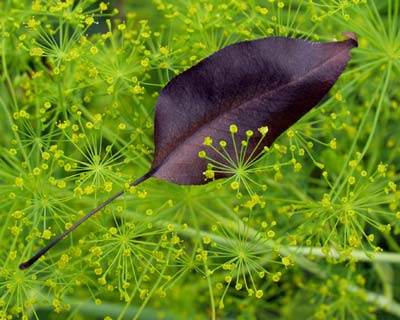
Here’s a good example of how the camera lends permanence to something temporarily beautiful. Obviously, the leaf was already dying when I took this picture, yet you might assume that the bush lives on. But this was at Cox Arboretum, where they frequently make radical changes to the landscape. There is no longer any trace of the leaf or the bush, except in this photo. 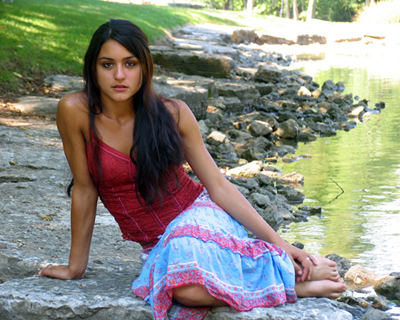
Because the camera lends permanence, Briana will always be sixteen years old, sitting beside a pond on a summer day. Perhaps in the future, some little kids will say, “Here’s that picture of grandma when she was sixteen.” I’m going to give this print to her family when the exhibition is over, so this very photo may serve as a perpetual memory. In that same sonnet I quoted earlier, Shakespeare also wrote, “So long as men can breathe or eyes can see, So long lives this, and this gives life to thee.” The second thing that the camera lends is closely related to the first. It lends us the ability to stop motion at a crucial instant so we can examine something that happens too quickly for our eyes to perceive. In fact, one of the earliest practical applications of the camera was to finally determine whether all four of a horse’s hooves left the ground when it galloped. In 1872, Eadweard Muybridge took this series of photos to prove that they did. 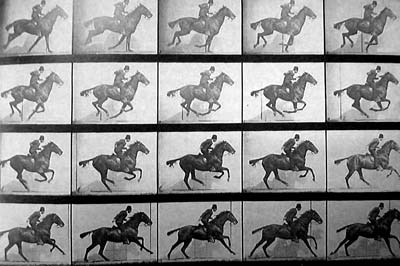
Now, of course, this is common knowledge, thanks to photographs. 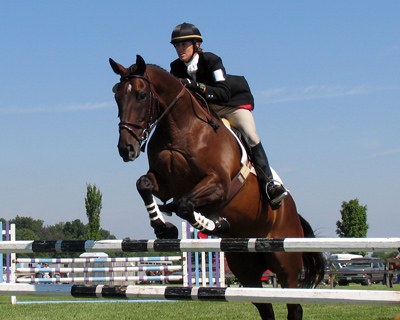
You can’t take a photograph of the past or the future, but cameras do pretty well with the present. And on a sunny day, the present can be sliced very thin, like this exposure taken at about 1/1000th of a second. 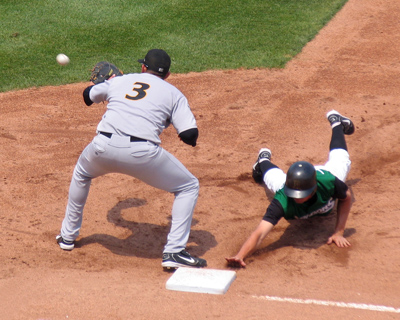
While the umpire has to make a call right away based on what his eyes tell him, the camera lends us the ability to judge the scene for as long as we like. So what’s the call? Safe or out? Another thing the camera lends is a fresh perspective on one’s surroundings. Yesterday one of my coworkers commented about this exhibit and said, “You take pictures of ordinary things, but you find something special in them.” Take this picture for example: 
Many of you are familiar with the Library building and have walked by this wall downstairs countless times. So have I, but on November 22, for some reason, I stopped and pointed my camera at it and obtained a fresh perspective. Likewise there is a statue downtown, and there is a window nearby. I’ve been past them time and time again, but only recently did my camera lend me this new vantage point. 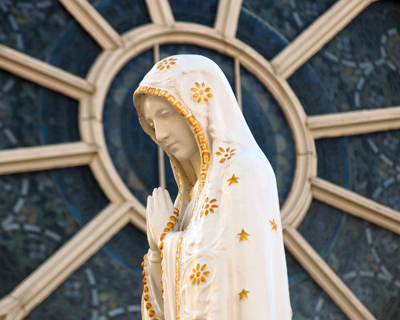
Whenever I look through the viewfinder of my camera, I can see only a small rectangle of reality. I can’t capture an image of everything above and below and around me. As a result, the camera lends a sensitivity to detail. 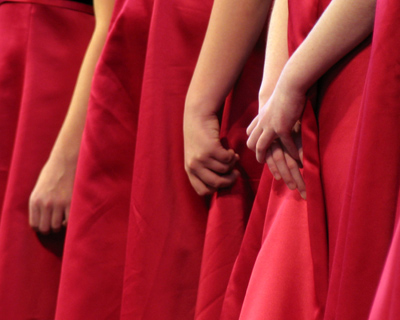
I think this is a far better picture than one that shows the faces of the singers in the choir. 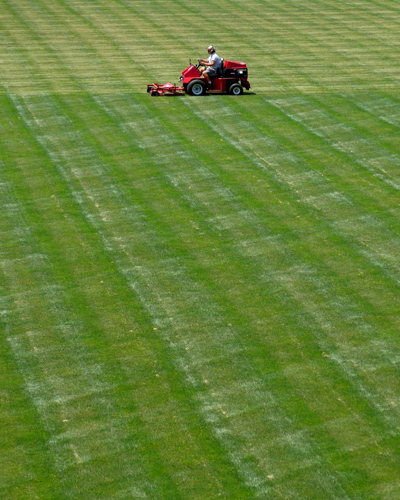
And even though the entire soccer field isn’t visible, this image still gives you a good sense of what the mower has accomplished and how much grass remains for him to cut. Truman Capote once wrote, “All art is composed of selected detail, either imaginary or . . . a distillation of reality.” Though I can’t say I have a particular photographic style, I usually seek out the detail rather than show the big picture. Sorry, but I guess you’ll just have to imagine what the rest of the building looks like. 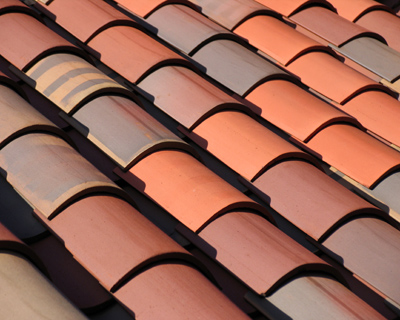
If I ever took a trip to the Grand Canyon, I would probably spend most of my time on my knees taking pictures of individual rocks on the ground. Finally, there’s one last thing that the camera lends: it provides a special kind of insight, and it reveals something important in every shot. Despite their different subject matter and the time of year they were taken, there’s one thing that each photo on the wall has in common. They were all taken by me, so the camera lends insight into who I am, what I do, where I go, and what I like and dislike. People who look at my daily photos page on a regular basis may feel fairly well acquainted with me, like they might if they were reading an online journal. They’re probably aware that I don’t watch television, for instance, but that I do like raspberry tea. Although the camera is rarely pointed at me, you can come to understand who I am by what I point the camera at. Last summer when we were making plans for the photography workshop at Woodland, someone came up with a good idea that we never found the time to follow through on. We thought it would be interesting to mark off a small area of the cemetery and allow the three presenters (Skip Peterson, John Lemker, and me) to go there separately and take a picture. I’m confident that we would’ve come back with significantly different images, because we’re unique individuals with our own sense of vision. I try to share that sense with you when I put daily pictures on my Web site, or when I have an occasional photo exhibition. My last quotation isn’t by a poet, but from a man named Bill Jay who wrote an essay called “The Thing Itself” that is very closely aligned with my own ideas about photography. At one point in the article, he says:
The photographer is, first and foremost, a selector of subjects . . . (making) a conscious choice from the myriad of possible subjects in the world . . . The photographer walks through life pointing at people and objects; the aimed camera shouts, “Look at that!” . . . Every time a viewer looks at a print, the photographer is saying, “I found . . . this interesting, significant, beautiful or of value . . . (and) I want you to appreciate it too.” Fortunately my camera lends me the ability to share these scenes with you, because without it you’d probably get tired of me calling you up and saying, “Hey, come over here and look at this!” To conclude, I would like to thank my coworkers Caroline Phipps, Jim Blair and Klint Kollmeyer for helping me arrange for this exhibit and reception. I’d also like to thank my nephews Luke and Caleb Combs who hung nearly every picture in the show. Nothing has fallen off the walls, and the photos are aligned with laser-guided precision. And once again, I’d like to thank each of you for coming tonight. |